What Are Agentic Commerce & AI Infrastructure Services?
My Agentic Commerce & GEO Infrastructure Services deploy a dual-storefront architecture that serves both human consumers and machine agents. By engineering a canonical Source of Truth (SoT), deploying Model Context Protocol (MCP) servers, and enforcing deep Knowledge Graph structures, we make your digital assets fully machine-readable, verifiable, and transaction-ready for the agentic economy.
The rapid shift from static, human-facing websites to autonomous AI experiences has created a critical “Findability Crisis” for modern brands. While consumers and enterprise buyers increasingly rely on AI assistants (ChatGPT, Gemini, Copilot, Claude) and autonomous purchasing agents to discover, evaluate, and transact, legacy web architectures built for 2000s-era browser sessions are failing.
When AI agents attempt to parse heavily dynamic JavaScript frameworks, unverified entity references, or unstructured product feeds, they face severe execution blocks. If an AI agent cannot verify a brand’s core claims, product specs, or pricing in real-time, that brand is excluded from synthesized recommendations and automated purchasing loops.
For further strategic insights, visit Alan Rambam’s LinkedIn Profile.
Why Does Agentic Commerce Demand an Architectural Overhaul?
Agentic commerce demands an architectural overhaul because AI agents do not “browse” a site; they extract structured data chunks, query APIs, and validate entity relationships against global trust networks. Traditional digital strategies relied on visual user interfaces (UI), A/B testing, and paid search acquisition. In the agentic era, the Logic Layer dominates.
Failing to establish a dedicated machine-facing infrastructure creates severe commercial vulnerabilities:
- The 99.5% AI Visibility Loss: Without machine-readable structure, even major enterprise brands are omitted from up to 99.5% of available AI interaction volume.
- Identity Confusion & Narrative Bleed: Unstructured brand references lead to model hallucinations, confusing distinct brands, founder identities, or competitor products.
- Ineffective Paid AI Advertising: Paid LLM advertising relies directly on organic machine-readable trust signals. Unverified ad claims suffer low model confidence scores, causing AI engines to filter out paid placements as ungrounded noise.
- The Safety Net Fallback: When agents encounter unreadable JavaScript or incomplete schemas, over 41% of AI traffic defaults to internal site search, resulting in direct loss of high-intent transactional buyers.
What Is the Two-Storefront Framework?
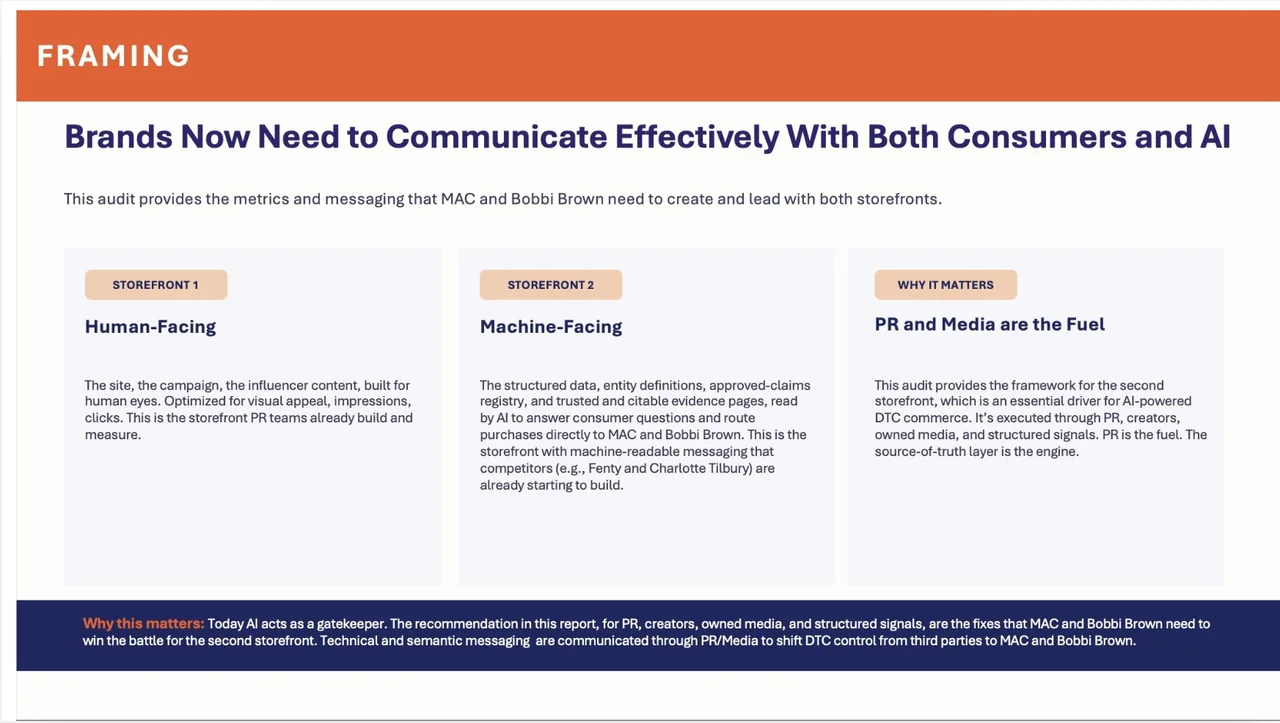
The Two-Storefront Framework runs a human-facing storefront and a machine-facing storefront side by side, both fed by one enterprise canonical Source of Truth and RAG pipeline and kept in sync through content and data pipelines. Our Agentic Overhaul establishes explicit synchronization between what your human customers experience and what autonomous AI agents ingest.
| Capability / Layer | Human-Facing Storefront (Storefront 1) | Machine-Facing Storefront (Storefront 2) |
|---|---|---|
| Primary Audience | Human shoppers, media editors, creators, and visual browsers. | AI assistants (Gemini, Copilot, ChatGPT), LLM crawlers, and Autonomous Buying Agents. |
| Technical Format | Dynamic, personalized visual interfaces and rich media. | Server-side pre-rendered static HTML (DOM) and raw data endpoints. |
| Data Structure | Visual layouts, promotional banners, and styled copy. | Deep JSON-LD schema, RDF triples, and Knowledge Graph nodes. |
| Content Retrieval | Page-level browsing and visual navigation. | H1 Answer Capsules, self-answering H2 chunks, and RAG vectorization. |
| Integration Protocols | Standard browser HTTP, web forms, and standard checkout UI. | Model Context Protocol (MCP) APIs, llms.txt, and direct commerce endpoints. |
Storefront 1 also carries PR outreach and editor briefs, creator and influencer messaging, and marketplace and retail listings, so those channels draw on the same Source of Truth as the machine-facing layer.
Phase 1 (Months 0–1): How Is Narrative Bleed Stopped and the Brand Trust Core Established?
Phase 1 of the six-month Agentic Transformation Roadmap fixes critical technical blockers, eliminates identity confusion, and establishes the foundational Source of Truth (SoT). The full roadmap runs in three phases that audit, re-architect, and activate your platform for autonomous AI discovery and transaction.
- Pre-Rendering & DOM Cleanup: Implement server-side pre-rendering (e.g., Prerender.io) to eliminate dynamic client-side JavaScript execution barriers. Clean DOM console errors and raw CDN scripts to ensure pristine AI context windows.
- Root llms.txt Manifest Deployment: Serve verified llms.txt files at root domain levels to guide AI crawlers directly to authoritative brand data, product specifications, and approved claims.
- Off-Page Entity Reconciliation & Brand Schema: Deploy nested JSON-LD schema blocks (Organization, Brand, Person, Product) linking internal nodes directly to global ground-truth databases (Wikidata, Wikipedia, SEC filings).
- Backend Counter-Claim Registry & RAG Feed: Establish a structured counter-claim data store feeding RAG pipelines with verifiable facts regarding brand policies, ingredient safety, and official press statements.
- Marketplace & Catalog Normalization: Synchronize external product listings (such as Amazon Premium Beauty or third-party marketplaces) with internal GTIN/UPC schemas to prevent unstructured merchant data from diluting AI entity clarity.
- Baseline Prompt Testing & Visibility Analytics: Stress-test a 50+ prompt library across ChatGPT, Gemini, Claude, Perplexity, and Copilot to benchmark initial AI Share of Voice and identity confusion rates.
Phase 2 (Months 2–3): How Are Retrieval, Synthesis, and Human Validation Activated?
Phase 2 of the Agentic Transformation Roadmap re-engineers on-page content structures for RAG chunk extraction and deploys specialized machine-readable formats.
- H1 Answer Capsules: Place 40–60 word standalone, branded summary paragraphs directly beneath main H1 headings across priority product and category pages.
- Self-Answering H2 Chunks: Structure body copy into 150–400 word modular sections opening with direct summary sentences and blockquote claim definitions, aligning with RAG chunking parameters.
- Copilot Comparison Tables: Ingest clean, structured HTML tables in top-of-page positions comparing product attributes, coverage, performance stats, and formulation details.
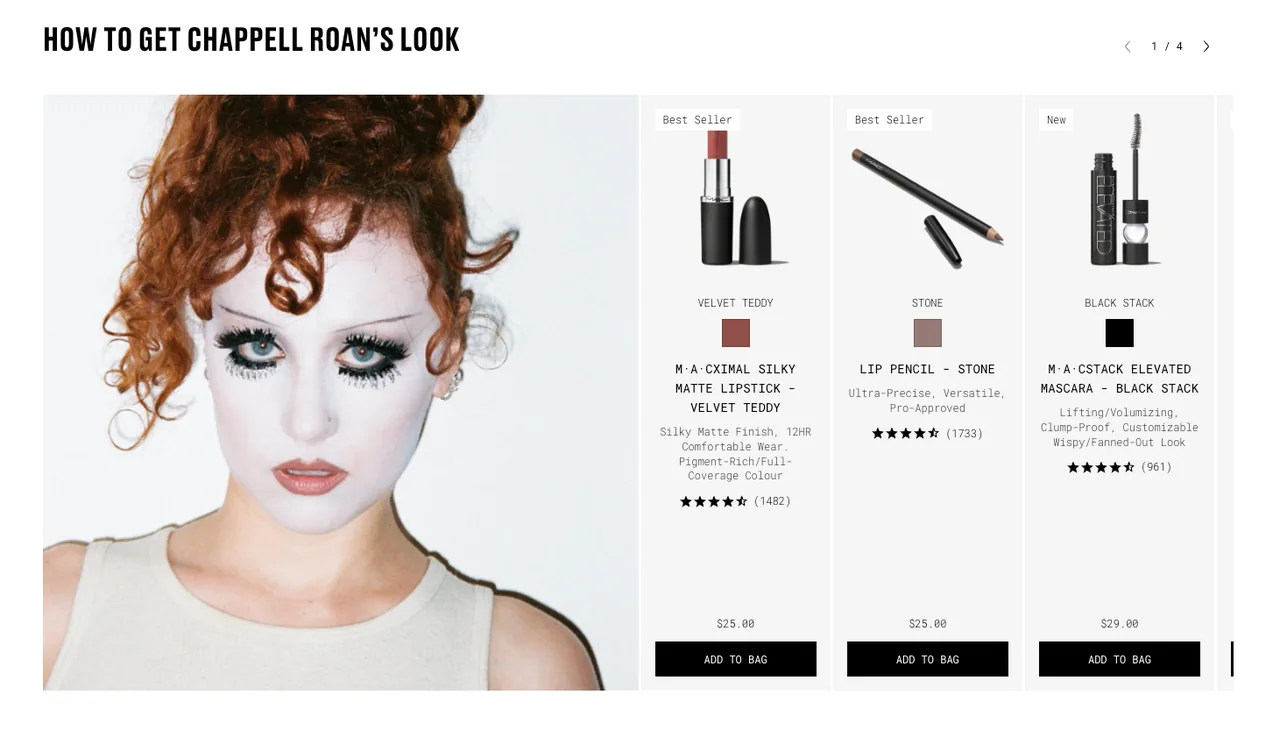
- Custom Product Array Schemas: Build schema arrays mapping cultural moments, influencer looks, or trending use cases directly to specific product SKUs to capture unclaimed category intent.
- PR & Media Vocabulary Governance: Audit external communications to eliminate vocabulary overlap with competitors, distributing machine-verifiable fact sheets to AI-trusted media sources.
- Community & Creator Signal Anchoring: Anchor verified creator video transcripts and seed inline entity-connected discussions across authoritative community channels (e.g., Reddit, trusted industry publications).
Phase 3 (Months 4–6): How Is a Brand Made Ready for Autonomous Agentic Commerce?
Phase 3 of the Agentic Transformation Roadmap connects your internal enterprise systems directly to AI ecosystems, enabling seamless, autonomous AI interaction and transaction.
- Real-Time Enterprise RAG Pipeline: Connect RAG pipelines directly to enterprise PIM/CMS platforms, automatically vectorizing shade grids, inventory updates, clinical test results, and pricing changes.
- Model Context Protocol (MCP) Server Deployment: Deploy dedicated in-house MCP servers in front of commerce platforms (Salesforce Commerce Cloud, Shopify Plus, custom APIs). Expose machine-readable catalogs, real-time inventory, and checkout endpoints to prepare for autonomous AI shopping agents.
- Outbound Authority Citations: Integrate outbound links to authoritative scientific, regulatory, or academic sources (e.g., INCI, FDA, PubMed) within schema blocks to maximize trust scores in retrieval models.
- Amazon Review Schema Ingestion: Parse verified positive customer reviews into structured JSON-LD schema on core DTC sites, feeding authentic human validation back into the Knowledge Graph.
- Continuous Statistical Measurement: Execute automated monthly prompt sweeps tracking citation ownership, selection efficiency, and competitor displacement across all major AI engines.
Which KPIs and Governance Tracks Measure Agentic Commerce Progress?
Agentic commerce progress is tracked across five operational tracks, each with a monthly KPI target. To evaluate progress, our deliverables are measured against rigorous technical and AI performance benchmarks:
| Operational Track | Strategic Scope & Primary Deliverables | Key Monthly KPI Target |
|---|---|---|
| Knowledge Graph, RAG & Schema | Off-page entity reconciliation, deep nested JSON-LD, counter-claim registry, MCP agentic server deployment. | Official Citation Rate: > 15% across primary category queries. |
| Technical Infrastructure | Pre-rendering deployment, llms.txt integration, DOM cleanup, H1 capsules, self-answering H2 chunks. | Page Readability Score: > 85% across machine evaluation tools. |
| PR & Brand Alignment | Fact sheet distribution, executive/SME authority anchoring, vocabulary governance, media alignment. | Identity Confusion Rate: < 2% across LLM synthetic queries. |
| AI Search & Discovery | Creator transcript structuring, community seeding, Bing Webmaster AI tracking, structured prompt testing. | Selection Efficiency: > 30% inclusion in top recommendation lists. |
| Marketplace & Catalog Alignment | Canonical GTIN mapping, listing copy synchronization, Brand Registry enforcement, review schema ingestion. | Purchase Routing Leakage: 0% leakage to unauthorized seller listings. |
Ready to prepare your web infrastructure for autonomous AI shopping agents? Establish your brand’s dual-storefront architecture and secure your place in the future of agentic discovery. Connect directly via Alan Rambam’s LinkedIn Profile or visit Rambam.com to schedule an Agentic Readiness Evaluation.
FAQ
Agentic Commerce FAQ: Architecture, MCP, and Identity Confusion
What is Agentic Commerce and why is static website architecture failing?
Agentic commerce refers to the shift where autonomous AI agents and AI assistants evaluate, recommend, and complete purchases on behalf of consumers. Legacy websites rely on visual layouts and dynamic JavaScript designed for human eye navigation. AI agents require structured logic, static pre-rendered DOMs, and API endpoints; without these, they cannot interpret or verify product data, leaving the site invisible.
How does the “Two Storefront” model work in practice?
The Two Storefront model maintains your existing visual, brand-rich storefront for human visitors while serving a parallel, machine-optimized layer for AI agents. The machine layer delivers server-side pre-rendered static HTML, deep JSON-LD schema, H1 Answer Capsules, llms.txt manifests, and Model Context Protocol (MCP) APIs, keeping both layers synchronized via backend data pipelines.
What is a Model Context Protocol (MCP) Server and why is it essential for AI agents?
Model Context Protocol (MCP) is an open standard that allows AI models to communicate securely with external business systems and databases. By deploying an MCP server in front of your commerce platform, AI agents can query product catalogs, verify real-time inventory, calculate taxes, and execute checkout workflows programmatically without breaking on dynamic web pages.
How does Agentic Optimization prevent AI identity confusion and hallucinations?
Identity confusion occurs when an AI model blends details about your brand with competitors, individuals, or unauthorized third-party listings. We eliminate this by deploying deep nested schema that explicitly links your brand to parent organizations, canonical GTIN numbers, and ground-truth nodes (such as Wikidata), establishing an undisputed canonical entity graph.
FAQ
Agentic Commerce FAQ: Paid AI Advertising, Content Chunks, and Results
Why does paid AI search advertising fail without underlying GEO infrastructure?
AI engines evaluate advertising claims against internal trust and confidence scores. If an AI ad claims a product is “the top dermatologist-recommended solution,” but the brand’s machine-readable schema and ground-truth references fail to verify that claim, the AI model lowers its confidence score and filters the ad out as unverified noise.
What are H1 Answer Capsules and H2 Chunks?
Because AI models retrieve information in short text segments (“chunks”) rather than reading entire pages, content must be structured accordingly. H1 Answer Capsules are 40–60 word standalone summary paragraphs positioned immediately under main page titles, while H2 Chunks are 150–400 word sections opening with direct answers, ensuring RAG vector engines extract clear, citation-ready facts.
What results can brands expect after an Agentic Commerce overhaul?
In active enterprise pilot programs combining deep entity mapping, page reformatting, and RAG optimization, clients have experienced up to a 740% increase in active users, a 720% increase in new users, and over a 200% improvement in AI selection efficiency within 60 days of deployment.
Selected visual evidence
Images that ground the story