Why Is GEO Infrastructure Rather Than a Marketing Tactic?
GEO is not just a marketing tactic; it is core technical infrastructure. For too long, organizations have debated GEO line-items as if they were discretionary marketing experiments, comparing them to monthly SEO retainers or standard keyword tracking tools. This approach fundamentally misinterprets the massive technological shift taking place.
We are rapidly transitioning from the era of Visual Discovery to Machine Discovery. Traditional marketing optimizes for human eyes browsing a website. Infrastructure-level GEO constructs a permanent, machine-readable backend that allows autonomous AI agents, Retrieval-Augmented Generation (RAG) pipelines, and multi-entity comparison engines to ingest, verify, and transact with your enterprise.
Understanding this structural reality elevates GEO from a basic visibility software subscription to a C-suite, enterprise-level architectural imperative.
The sections below cover the two storefronts every enterprise now operates, how the infrastructure applies across industries, why it expands the addressable market, and its impact on revenue and paid AI advertising.
For more on building enterprise machine-readable foundations, visit Alan Rambam’s LinkedIn Profile.
What Is the Difference Between Visual Discovery and Machine Discovery?
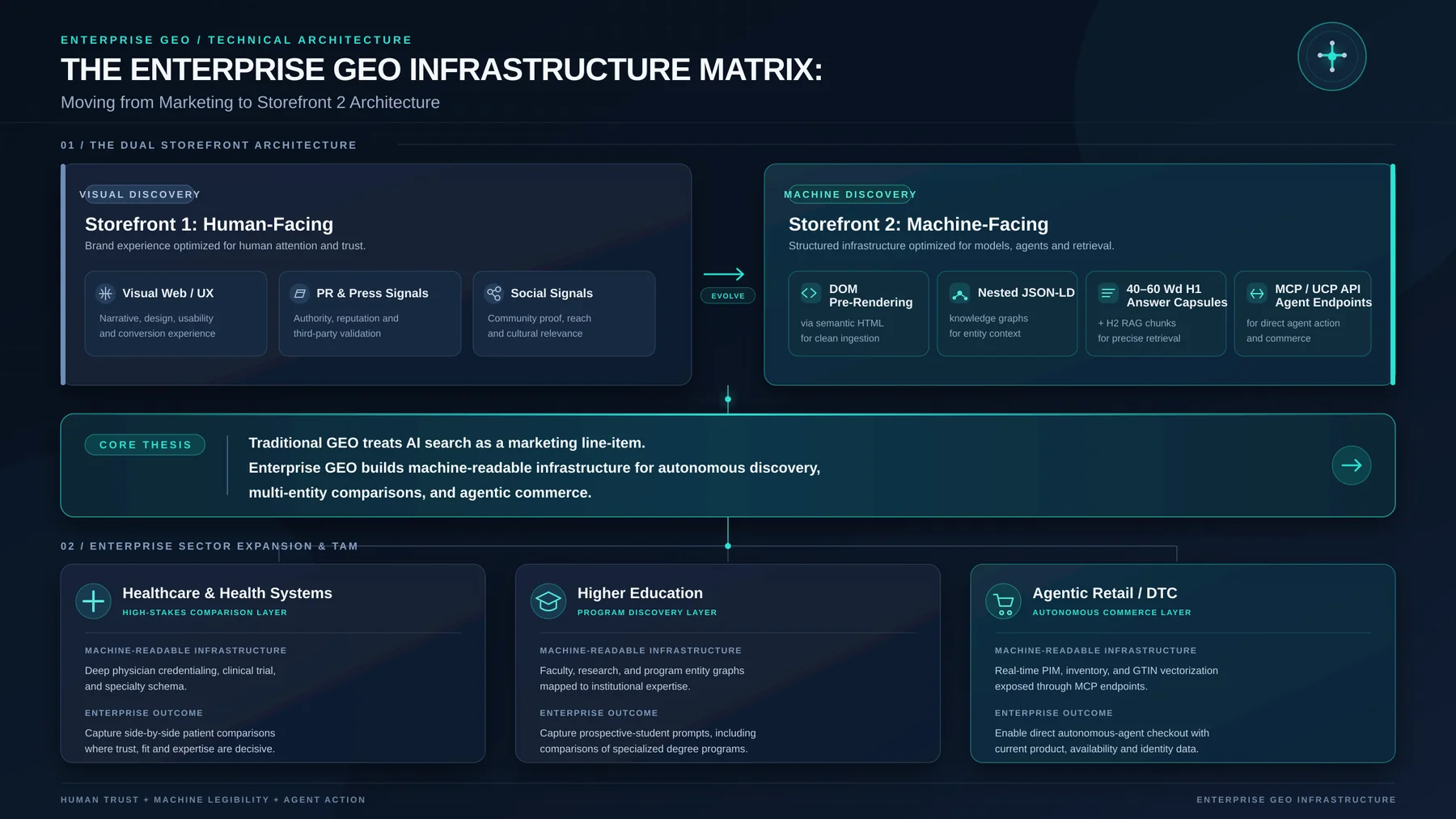
Visual Discovery serves humans browsing a website, while Machine Discovery serves AI agents reading structured data. The modern enterprise must now operate two distinct web architectures simultaneously: a human-facing front end (Storefront 1) and a machine-facing back end (Storefront 2), kept in sync via data pipelines.
Storefront 1: Human-Facing Visual Discovery
Storefront 1 represents the traditional visual web. It includes dynamic JavaScript frameworks, visual storytelling, personalized user interfaces, social media proof, and legacy PR. It is optimized for human attention, emotional engagement, and browser-based clicks.
Storefront 2: Machine-Facing Infrastructure
Storefront 2 represents the Brand Trust Layer, a deterministic, 100% machine-readable backend built specifically for AI crawlers, LLMs, and autonomous shopping agents. It consists of:
- Server-Side Pre-Rendered DOMs: Eliminates JavaScript execution barriers so LLM crawlers ingest clean, static HTML.
- Nested JSON-LD Entity Knowledge Graphs: Provides structured context mapping organizational relationships, products, SMEs, and patents directly to global ground-truth nodes (e.g., Wikidata).
- Answer Capsules & RAG Chunking: Formats text into 40–60 word H1 summaries and self-answering H2 chunks designed for vector retrieval windows.
- Model Context Protocol (MCP) Endpoints: Exposes real-time PIM databases, live inventory, and checkout APIs directly to AI agents.
Without Storefront 2, your enterprise is functionally invisible to the machine economy.
How Does GEO Infrastructure Apply Across High-Stakes Industries?
GEO infrastructure applies wherever AI systems compare complex options on a buyer’s behalf, including healthcare, higher education, and agentic retail. To illustrate how GEO scales as technical architecture across high-stakes industries, the Enterprise GEO Infrastructure Matrix below outlines the transition from marketing line-items to Storefront 2 infrastructure:
| Sector / Vertical | The High-Stakes Comparison Layer | Machine-Readable Infrastructure Required | Enterprise Outcome |
|---|---|---|---|
| Healthcare & Health Systems | Complex clinical trials, specialist credentials, and treatment comparisons. | Deep physician credentialing, clinical trial datasets, and specialty medical schema. | Captures side-by-side patient research prompts where clinical authority is decisive. |
| Higher Education | Degree tracks, faculty research, and institutional alignment. | Faculty expertise graphs, research paper schemas, and program entity mapping. | Dominates agent-driven student discovery across platforms like Perplexity and Canvas AI tools. |
| Agentic Retail & DTC | Autonomous shopping agents executing real-time checkouts. | Real-time PIM feeds, GTIN vectorization, and live inventory exposed via MCP endpoints. | Enables direct, autonomous checkout without requiring a human to visit a browser. |
In each sector the pattern is the same: the comparison happens inside the AI system, so the enterprise outcome depends on the machine-readable infrastructure behind the brand.
Why Does GEO as Infrastructure Expand Enterprise TAM?
GEO as infrastructure expands the total addressable market (TAM) because re-architecting an enterprise’s web presence is a far larger undertaking than a visibility-monitoring subscription. Many industry platforms currently pitch GEO as simple “AI Visibility Monitoring” or “AEO Tracking,” treating it as a standard SaaS subscription funded by leftover marketing budgets. This severely understates the scope of the problem and limits TAM potential.
When evaluated as an infrastructure overhaul, the equation changes:
- Page-Scale Re-Engineering: A major enterprise brand with thousands of product pages (for example, MAC Cosmetics with over 2,200 pages) requires a complete technical reformatting of its DOM, schema layer, and content chunking to support agentic commerce.
- Multi-Brand Enterprise Rollouts: Multi-brand conglomerates (such as Estée Lauder Companies with 20+ global brands) face a total infrastructure gap across tens of thousands of digital touchpoints.
- C-Suite Investment Level: Re-architecting a website into a dual-storefront platform transitions GEO from a minor monthly marketing expense into a core C-suite enterprise infrastructure initiative.
What Is the Business Impact of GEO Infrastructure on Revenue and AI Advertising?
Building a machine-readable foundation yields direct, quantifiable financial returns, and it also determines whether paid AI advertising can perform.
Real-World Case Study: The Ford Dealership Revenue Engine
Alan Rambam engineered a machine-readable intent engine for Ford’s top-volume dealership. By structuring inventory and localized entity intent for machine discovery, the dealership generated over $200M in revenue and experienced a 1,457% increase in leads compared to regional averages.
Following an acquisition by Penske, the new owners turned off the machine-readable backend, believing it was an unnecessary marketing cost. Within the first year, web traffic dropped by 50%, and the dealership lost its #1 volume ranking.
The AI Ad Connection: Programmatic Machine Trust
GEO infrastructure is equally essential for paid AI search advertising. As AI search engines scale their ad monetization models, ad placements will rely heavily on automated machine confidence scores.
If an AI engine cannot programmatically verify your inventory, compliance, pricing, or underlying entity claims via Storefront 2 schema, it will lower your brand’s confidence score. In an agentic ad auction, unverified ads are filtered out as unreliable noise. Without GEO infrastructure, paid AI ad spend is severely compromised.
Is your enterprise ready for the transition to Machine Discovery? Stop treating GEO as an optional marketing tactic and start building the machine-readable foundation your business needs to remain discoverable, comparable, and transactable. Connect directly via Alan Rambam’s LinkedIn Profile or visit Rambam.com to explore enterprise GEO infrastructure services.
FAQ
GEO as Infrastructure FAQ: Definition, Storefront 2, and MCP
What does “GEO as Infrastructure” mean?
GEO as Infrastructure means treating Generative Engine Optimization not as a temporary marketing campaign, but as a permanent, backend technical architecture. It involves building a machine-facing storefront (Storefront 2) equipped with pre-rendered DOMs, deep JSON-LD schema, and MCP API endpoints that AI agents require to discover and process your brand.
What is Storefront 2 and how does it differ from Storefront 1?
Storefront 1 is your human-facing, visual website optimized for design, visual branding, and browser interaction. Storefront 2 is your machine-facing architecture designed specifically for LLMs, AI crawlers, and RAG pipelines, providing structured, deterministic data without the overhead of client-side JavaScript.
What is the Model Context Protocol (MCP) and why is it part of GEO infrastructure?
Model Context Protocol (MCP) is an open API standard that enables AI models to query external databases directly. In GEO infrastructure, MCP endpoints allow autonomous AI agents to check live product inventory, verify pricing, and execute purchases directly from your commerce platform.
FAQ
GEO as Infrastructure FAQ: JavaScript, AI Advertising, Risk, and Getting Started
Why are dynamic JavaScript websites unreadable for AI agents?
Heavy client-side JavaScript frameworks require significant browser processing to render content. AI crawlers operating under strict compute time limits often fail to execute complex client-side scripts, causing them to miss buried product information, pricing, or specifications. Pre-rendering static HTML solves this issue.
How does GEO infrastructure impact paid AI search advertising?
AI ad networks rely on automated confidence scores to verify whether an advertiser’s claims are accurate. If your brand lacks structured JSON-LD schema confirming your ad copy, the AI engine lowers your trust score and deprioritizes your paid placement in favor of fully verified competitors.
What happens to companies that ignore machine discovery?
As consumer and B2B research shifts toward AI assistants, companies lacking Storefront 2 infrastructure face the “Findability Crisis.” They risk becoming invisible to AI recommendations, losing traffic to machine-readable competitors, and being excluded from automated B2B procurement pipelines.
How does an enterprise begin a GEO infrastructure overhaul?
An enterprise overhaul begins with an AI Language & Readability Audit across all digital properties to map the Citation Gap, evaluate DOM accessibility, identify missing schemas, and establish a clear engineering roadmap for Storefront 2 deployment.