Why Does Every Brand Need a Second Storefront?
Every brand needs a second storefront because traditional websites act as human showrooms and are often invisible or confusing to machine intelligence. For decades, the standard playbook for digital commerce was simple: build a high-converting, visually compelling website for human eyes, drive traffic through traditional SEO and paid ads, and optimize for clicks. That model is officially behind us.
Today, over 73% of consumers use AI tools somewhere in their shopping journey, and when conversational engines (ChatGPT, Gemini, Perplexity, Copilot) recommend a brand, that referral converts at nearly four times the rate of standard web search.
Dynamic JavaScript, buried copy, and unverified claims create machine friction. To succeed in the era of Generative Engine Optimization (GEO) and Agentic Commerce, every enterprise must deploy a parallel operating foundation: The Brand Trust Layer.
- Storefront 1, the Human Showroom: Optimized for visual UX, brand narrative, and emotional engagement.
- Storefront 2, the Brand Trust Layer: A deterministic, machine-readable backend designed for AI reasoning, synced with Storefront 1 via data pipelines.
The Brand Trust Layer is the machine-readable backend that gives AI models the deterministic confidence, entity boundaries, and structured proof required to verify, trust, and cite your brand.
For more on building machine-readable trust frameworks, visit Alan Rambam’s LinkedIn Profile or my AI portfolio at rambamai.com.
What Is the 5-Level Brand Trust Layer Pyramid?
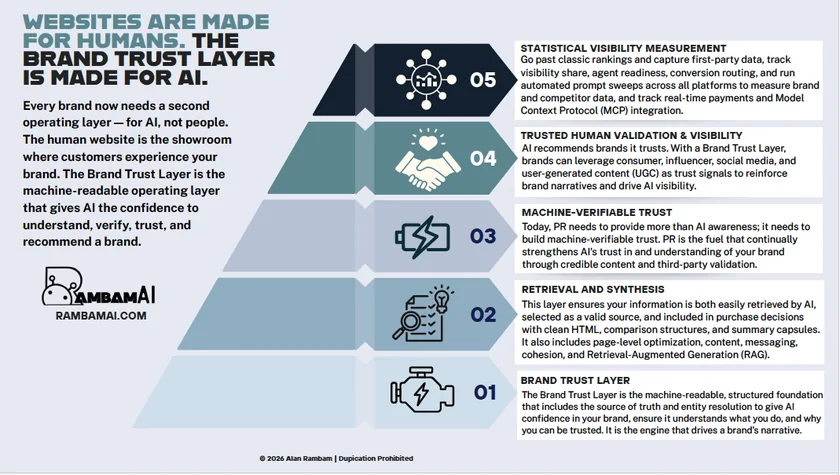
The Brand Trust Layer Pyramid is an integrated five-level architecture. Each level builds upon the last to transform your brand from an unverified web page into an indisputable, machine-callable source of truth. From the base of the pyramid to the top:
- Level 01: Brand Trust Core (Knowledge Graph). The foundation: giving AI algorithmic confidence in who you are.
- Level 02: Retrieval & Synthesis (Page GEO). The engine: architecting on-page copy for seamless LLM chunk extraction.
- Level 03: Machine-Verifiable Trust (PR Fuel). The verification: supplying high-authority evidence that AI algorithms trust.
- Level 04: Trusted Human Validation & Visibility. The reinforcement: leveraging community consensus to validate brand claims.
- Level 05: Statistical Visibility Measurement. The scorecard: moving past classic rankings to track AI Share of Model.
The order matters. An AI engine has to know who the brand is before page content can be retrieved, on-page claims have to exist before third-party sources and communities can confirm them, and measurement at the top reports on how well the four levels beneath it are working.
Levels 01 and 02: How Does a Brand Establish Entity Identity and Retrievable Content?
Levels 01 and 02 of the Brand Trust Layer are built on the brand’s own site: Level 01 defines the brand entity in a knowledge graph, and Level 02 structures page content so AI engines can extract it.
Level 01: Brand Trust Core (The Knowledge Graph & Entity Layer)
The foundation: giving AI algorithmic confidence in who you are. Before an AI engine can recommend your products, it must unambiguously define your brand entity. Level 01 establishes strict entity boundaries through:
- Off-Page Entity Reconciliation: Aligning official profiles across Wikidata, LinkedIn, Google Knowledge Graph, and corporate filings.
- Deep Nested Schema: Hardcoding JSON-LD schema blocks (Organization, Brand, Person, Product) directly within the server-side DOM payload.
- The Counter-Claim Registry: Creating a machine-readable data store of verified facts (clinical test data, certifications, cruelty-free policies) that feeds RAG pipelines to eliminate AI hallucinations at the source.
Level 02: Retrieval & Synthesis (Page-Level GEO & Content Architecture)
The engine: architecting on-page copy for seamless LLM chunk extraction. AI engines do not read web pages like humans; they ingest contextual chunks (400–600 tokens). Level 02 structures page architecture for maximum extraction efficiency:
- H1 Answer Capsules: Standalone 40–60 word summary paragraphs positioned directly below main headings, containing core entity stats designed for direct answer lifting.
- Self-Answering H2 Chunks: Modular 150–400 word body sections that open with direct summary claims and blockquote definitions.
- Copilot HTML Tables: Clean semantic <table> elements placed in top-of-page positions, which models like Microsoft Copilot reproduce verbatim in synthesized answers.
- Schema-Labeled Q&A Accordions: Explicit FAQPage markup targeting multi-constraint conversational queries.
Levels 03 to 05: How Is Brand Trust Verified, Reinforced, and Measured?
Levels 03 to 05 of the Brand Trust Layer work beyond the brand’s own pages: Level 03 supplies third-party editorial evidence, Level 04 adds human consensus, and Level 05 measures the result across AI models.
Level 03: Machine-Verifiable Trust (PR & Editorial Fuel)
The verification: supplying high-authority evidence that AI algorithms trust. When an AI engine evaluates an on-page claim, it cross-references third-party editorial sources, academic directories, and trade publications.
- PR as Engine Fuel: Once the Source of Truth is established, every PR story, media placement, and analyst report serves as fuel that continually trains and reinforces AI model trust.
- Structured Media Briefs: Distributing machine-readable press kits to external outlets that AI engines treat as ground-truth trust anchors.
Level 04: Trusted Human Validation & Visibility (Social Media & UGC)
The reinforcement: leveraging community consensus to validate brand claims. AI models heavily ingest community platforms (Reddit, YouTube transcripts, niche forums) to confirm whether corporate marketing claims match real-world consumer experience.
- YouTube Creator Integration: Structuring creator briefs so AI crawlers parse verified video transcripts for product tutorials and reviews.
- Authentic Community Seeding: Engaging in niche subreddits to seed organic discussions that AI engines digest as high-trust user sentiment.
- UGC Review Schema Ingestion: Ingesting verified user review data back into structured JSON-LD blocks on brand sites.
Level 05: Statistical Visibility Measurement
The scorecard: moving past classic rankings to track AI Share of Model. Legacy SEO rank tracking fails to capture multi-turn conversational AI interactions. Level 05 deploys an automated feedback loop:
- Structured Prompt Libraries: Testing libraries of 30–50 multi-constraint prompts reflecting complex buyer intent.
- Automated Model Sweeps: Programmatically tracking Mention Rate, Selection Efficiency (% of mentions converting to top choice), and Official Citation Rates across ChatGPT, Gemini, Perplexity, Claude, and Copilot.
- MCP & Agent Readiness: Integrating Model Context Protocol (MCP) endpoints to track real-time inventory, pricing, and agentic transaction routing.
How Does the Brand Trust Layer Connect Technical Work to Commercial Outcomes?
Each level of the Brand Trust Layer pairs a technical capability with a strategic role in machine discovery. The summary matrix below outlines how the five-level pyramid connects technical implementation with commercial outcomes:
| Pyramid Layer | Primary Technical Capability | Strategic Role in Machine Discovery |
|---|---|---|
| 01. Brand Trust Core | Knowledge Graphs, deep nested JSON-LD, off-page reconciliation. | Establishes unambiguous entity identity and algorithmic confidence. |
| 02. Retrieval & Synthesis | H1 Answer Capsules, self-answering H2 chunks, Copilot HTML tables. | Ensures content fits RAG context windows for instant citation extraction. |
| 03. Machine-Verifiable Trust | PR alignment, structured press kits, canonical source-of-truth feeds. | Acts as “fuel” that provides third-party evidence to train AI models. |
| 04. Trusted Human Validation | YouTube creator transcripts, Reddit community seeding, UGC review schema. | Supplies human consensus signals to validate brand claims. |
| 05. Statistical Measurement | Synthetic prompt sweeps, Share of Model tracking, MCP API integration. | Provides real-time C-suite analytics on AI visibility and agent readiness. |
Is your brand ready to build its second storefront? Establish the machine-readable foundation your enterprise needs to be understood, trusted, and recommended by autonomous AI. Connect directly via Alan Rambam’s LinkedIn Profile to explore my Brand Trust Layer services.
FAQ
Brand Trust Layer FAQ: Definition, PR, Answer Capsules, and UGC
What is the Brand Trust Layer?
The Brand Trust Layer is a machine-readable, structured operating foundation deployed alongside your traditional human-facing website. It includes a canonical Source of Truth, deep JSON-LD schema, entity reconciliation, and RAG-optimized content architecture designed specifically to give AI platforms the confidence to recommend your brand.
Why is PR described as the “fuel” for the Brand Trust Layer?
While the Brand Trust Layer provides the technical “engine,” AI models verify on-page claims by cross-referencing external sources. PR acts as fuel by securing structured media mentions, analyst reports, and high-authority editorial coverage that continuously reinforce the brand’s canonical facts in AI training data.
How do H1 Answer Capsules improve AI citations?
H1 Answer Capsules are 40–60-word standalone summary paragraphs positioned directly below main page titles. They contain key branded facts, product specs, and verified stats, matching the exact chunking and context window parameters used by LLM vector retrieval engines.
Can social media and User-Generated Content (UGC) influence AI recommendations?
Yes. AI engines actively scan community platforms (such as Reddit and YouTube transcripts) to evaluate human consensus. By aligning social briefs and ingesting verified UGC reviews into structured schema blocks, brands provide authentic validation signals that AI models trust.
FAQ
Brand Trust Layer FAQ: Storefronts, Metrics, and Conversion
What is the difference between Storefront 1 and Storefront 2?
Storefront 1 is the visual, human-facing website optimized for design, storytelling, and manual navigation. Storefront 2 is the machine-facing Brand Trust Layer, a deterministic backend consisting of pre-rendered static DOMs, entity schema, llms.txt manifests, and MCP endpoints for AI crawlers and autonomous agents.
What metrics are tracked in Level 05 Statistical Measurement?
Level 05 measures Share of Model (the percentage of category prompts where your brand appears), Selection Efficiency (how often mentions convert to top recommendations), Official Citation Rate, and real-time MCP agent transaction readiness.
Why do AI referrals convert at nearly 4x the rate of standard web search?
Users querying conversational AI assistants are typically further along in the decision-making process, presenting highly specific, multi-constraint prompts. When an AI assistant synthesizes data and explicitly recommends a single verified choice, the user receives a tailored recommendation rather than a list of blue links, resulting in significantly higher purchase intent.